

In UV printing applications, wooden products have always been a highly popular yet notoriously challenging material category. Many customers encounter issues during actual printing, such as:
blurred patterns, uneven colors, and edge bleeding, resulting in a “smudged” appearance.
The problem lies not with the UV printer itself, but rather in the surface condition of the wooden material.
If you are new to this process, you can first read our complete guide to UV printing on wood to understand the printing method, suitable wood materials, product applications, and printer options before learning about surface preparation.
The working principle of UV printing determines its “aversion to ink absorption.”
How UV Printing Works
UV ink is sprayed onto the material surface.
It is then instantly cured by ultraviolet light.
The ink forms a clear, three-dimensional pattern layer on the surface.
Key Factors
The ink must “remain on the surface” to be dried by the UV lamp.
Untreated raw wood is the arch-nemesis of UV printing
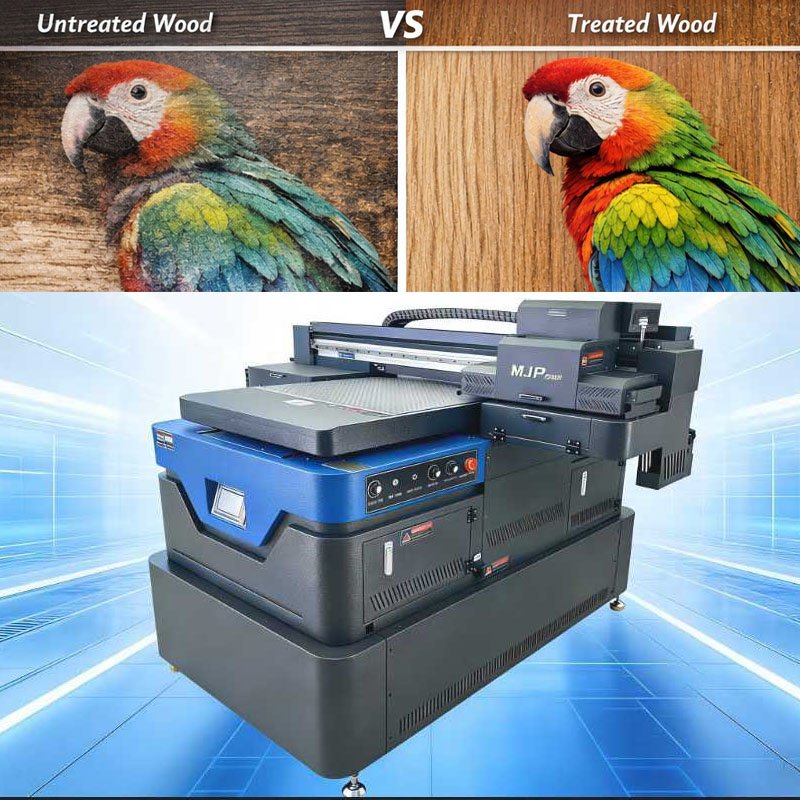
Natural wood products inherently possess several unavoidable characteristics
Loose fiber structure
Numerous pores
Extremely high ink absorption
When UV ink is sprayed onto untreated raw wood surfaces:
Before the ink can be cured by UV lamps,
it is already absorbed, permeated, and diffused by the wood.
This ultimately leads to
blurred pattern edges
faded, desaturated colors
loss of detail and overall diminished texture
This is the fundamental reason why many mistakenly believe “UV printing isn’t suitable for wood.”
Prerequisite for UV Printing on Wooden Products: Surface Treatment Must Be Applied First
If you desire clear, stable, and high-quality UV printing results, this step is non-negotiable:
Surface treatment of wooden products is the most critical factor.
Common effective treatment methods include
Applying clear varnish / white paint
Sealing pores with primer
Applying anti-ink-penetration coating
These treatments serve one core purpose:
Sealing wood pores to prevent ink penetration.
After treatment, the wood surface becomes
Smoother
Less absorbent
Ink stays fully on the surface
Only then can UV printing truly leverage the “print-and-dry-immediately” advantage of UV lamps.
How significant is the difference in results between treated and untreated wood?
| Comparison Item | Untreated Natural Wood | Treated Wood Surface |
|---|---|---|
| Ink Behavior | Ink absorbs quickly into the wood | Ink remains on the surface |
| Edge Sharpness | Edges spread and appear blurry | Edges are sharp and well-defined |
| Color Performance | Colors look dull and less saturated | Colors are vibrant and vivid |
| Printing Stability | High risk of printing defects | Suitable for stable mass production |
Whether or not to apply surface treatment almost entirely determines the success or failure of UV-printed wood products.
Applications for UV Printing on Wooden Products
After proper surface preparation, UV printing on wooden products is highly mature, such as:
Wooden signage
Custom wooden box packaging
Wooden decorative art
Home decor panels
Branded display boards
Not only are the patterns crisp, but they are also wear-resistant, waterproof, and suitable for commercial-grade production.
Summary: UV printing on wood isn’t technically difficult—understanding the process is key
The most critical factor in UV printing on wood isn’t the equipment, ink, or settings—it’s surface preparation.
Just remember this:
❌ Printing directly on untreated wood = high risk
✅ Printing after sealing the surface = consistent, high-quality results
This alone avoids 80% of the pitfalls beginners face when UV printing on wood.