
During daily UV printer operations, we often receive customer inquiries like these:
“Can UV ink that’s just expired by a month or two still be used?”
“The ink looks unchanged—it seems wasteful to discard it, right?”
Indeed, UV ink isn’t cheap, and discarding it outright is heartbreaking. But as a UV printer manufacturer, our advice is unequivocal:
We strongly advise against using expired UV ink. It’s best to dispose of it immediately.
Below, we’ll explain in detail from a professional perspective: Why can’t expired UV ink be used? What serious consequences might arise from using it?
The first issue with expired UV ink: Seriously degraded print quality
UV ink is not ordinary ink. Its composition includes:
Photosensitive resin
Pigments
Additives
Photoinitiators
Once past their shelf life, these components undergo changes, leading to a noticeable decline in print quality.
Common issues include
❌ Faded colors and inaccurate color reproduction
❌ Uneven color distribution with noticeable graininess in images
❌ Ink skipping, splattering, or stringing
❌ Blurred or unclear pattern edges
The ultimate consequence: 👉 Printed products become undeliverable, resulting in wasted materials and labor hours.
The damage caused by expired UV ink to equipment is far more severe than you might imagine
Many users underestimate the harm “expired ink” inflicts on equipment, yet the risks it poses are substantial.
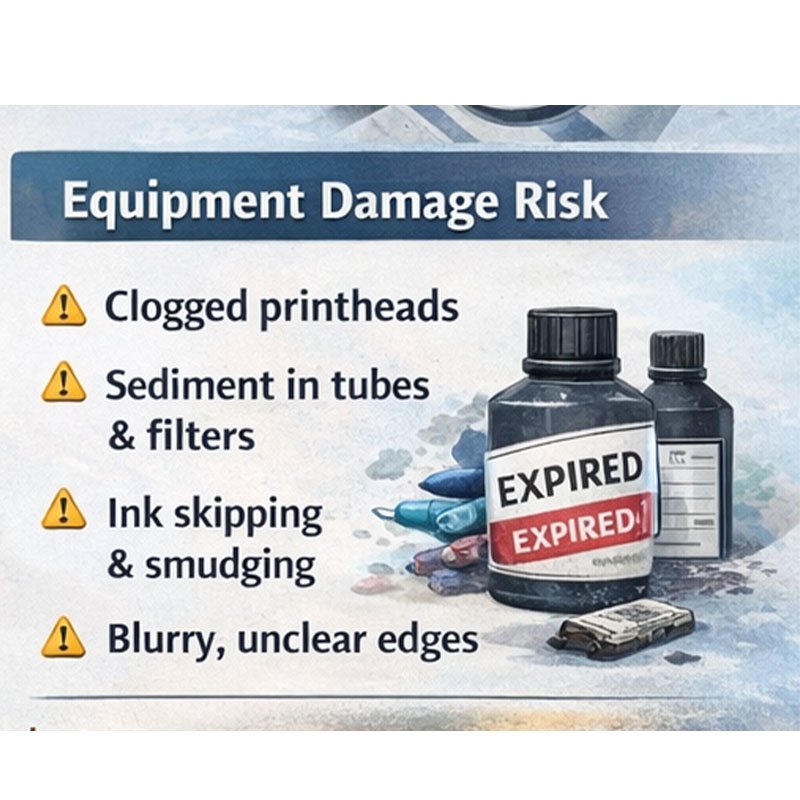
Sediment clogs the ink supply system
Expired UV ink is prone to:
Sedimentation
Particle coagulation
Abnormal viscosity
These impurities gradually clog:
Ink tubes
Filters
Ink reservoirs
Printhead and even failure
The printhead is one of the most critical and expensive components in a UV printer:
Expired ink has reduced flowability
Particles can wear down nozzles
Cleaning is extremely difficult
The cost of repairing or replacing a printhead far exceeds the price of a set of ink.
Trying to save a little on ink costs could end up costing you tenfold or more in repairs.
Increased risk of equipment failure, impacting normal production
Beyond direct hardware damage, expired UV ink also causes numerous hidden issues:
⚠️ Poor ink flow
⚠️ Frequent printer errors
⚠️ Mid-job shutdowns
⚠️ Inability to maintain continuous, stable production
For factories fulfilling orders, this translates to:
Delayed delivery schedules
Increased rework
Diminished customer satisfaction
Disruption to overall production planning
You save a little money but lose efficiency and credibility.
UV Ink Shelf Life Reference Guide
To assist in better assessment, here is a common shelf life reference range (assuming unopened and properly stored):
Standard UV Ink Shelf Life:
Imported UV Ink:
Typically around 12 months
High-quality variants may last up to 18 months
Domestic UV Ink:
Generally around 12 months
White Ink:
Shortest shelf life
Typically only around 6 months
⚠️ Once the labeled shelf life expires—even if only 1–2 months past—performance may become unstable.
UV Manufacturer’s Summary Recommendation: Don’t gamble with expired UV ink!
We fully understand customers’ reluctance to discard unused ink, but from a professional standpoint, expired UV ink is not worth any risk.
Our clear recommendations:
❌ Do not use any expired UV ink
❌ Do not risk equipment damage to save minor costs
✅ Stock ink reasonably based on shelf life; follow FIFO (First In, First Out)
✅ Strictly control usage cycles for white ink
Don’t let the cost of a single bottle of ink lead to nozzle damage, equipment downtime, and lost orders.
FAQ
Can you use Expired UV Ink?
No, Expired UV Ink should not be used.
Once UV ink passes its expiration date, its chemical stability decreases. This can lead to poor curing, color inconsistency, and serious printhead clogging. Even if the ink looks normal, internal components may have degraded.
What are the risks of using Expired UV Ink?
Using expired UV ink can damage both print quality and equipment.
Common risks include faded colors, weak adhesion, ink sedimentation, clogged nozzles, and unstable ink flow. In severe cases, it may cause permanent printhead failure and production downtime.
How long can UV ink be stored before becoming Expired UV Ink?
Most UV ink has a shelf life of approximately 12 months if unopened and properly stored.
White UV ink generally has a shorter shelf life of around 6 months. However, some high-quality white inks may last up to 12 months. Once the expiration date is exceeded, the ink becomes Expired UV Ink, and its performance stability may decline.
Does white ink expire more easily?
Yes, white UV ink is more likely to expire faster than other colors.
Due to its higher pigment concentration, white ink is more prone to sedimentation and viscosity changes. Once it becomes Expired UV Ink, the risk of clogging and print quality deterioration increases significantly.
What should you do if UV ink has expired?
Expired UV Ink should be discarded and never reused.
Do not mix it with fresh ink. To avoid unnecessary waste, follow the FIFO (First In, First Out) inventory management principle, store ink in a cool environment, and purchase according to your actual production needs.