In the past decade, glass film has been the most common solution for privacy and decoration in home interiors, office partitions, and commercial spaces. Traditional frosted glass film remains popular due to its simplicity, ease of use, and low cost. However, with rapid advancements in digital printing, a new technique is reshaping the market—UV printing on glass film using a UV flatbed printer.
This technology not only enhances the decorative capabilities of glass film but also redefines the aesthetics of glass spaces. This article will help you understand the differences between traditional frosted film and UV printing transparent film, the workflow, effect comparison, and practical applications.
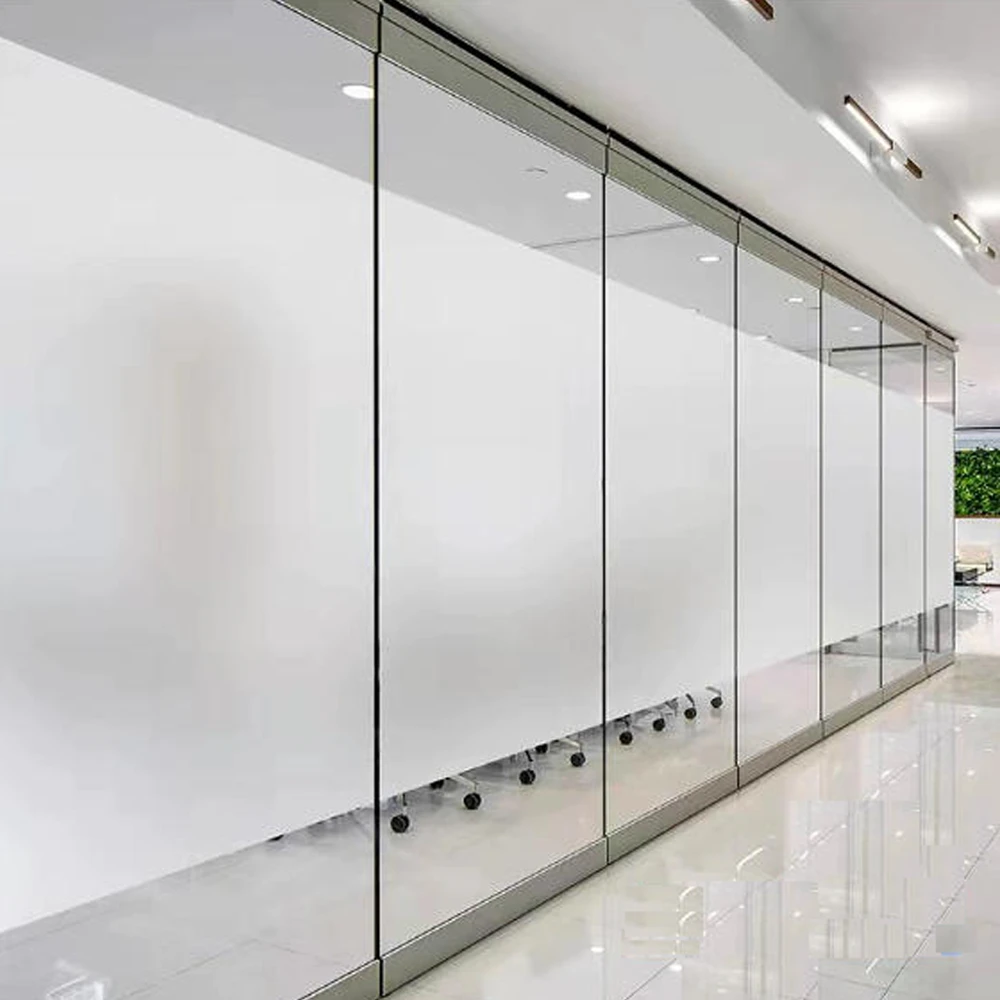
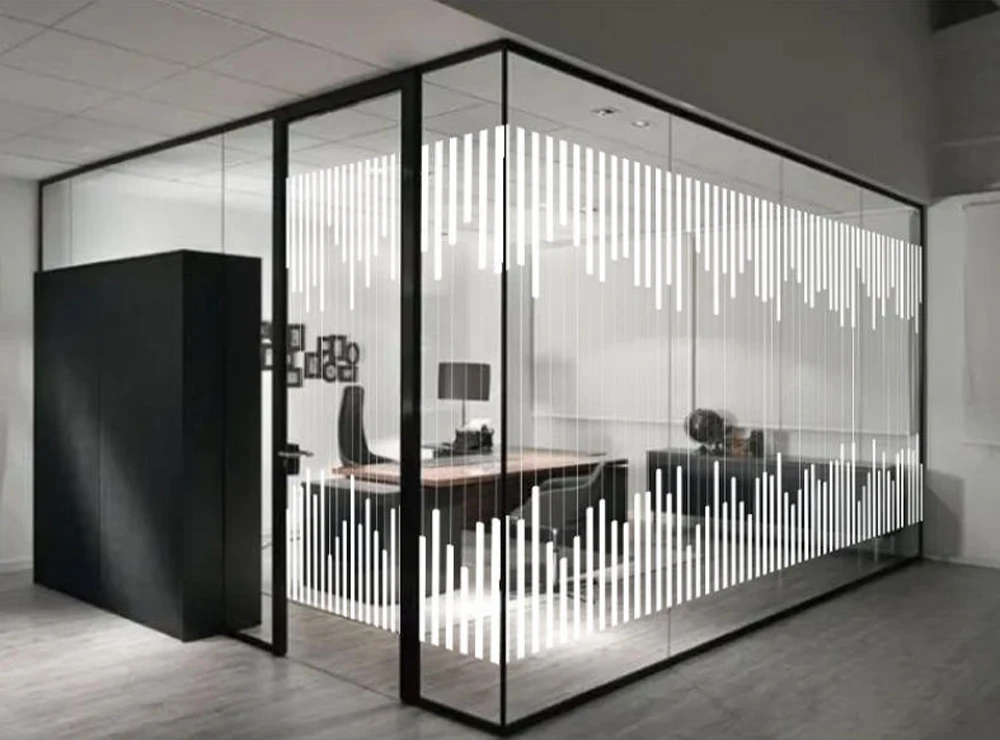
What is Traditional Frosted Glass Film?
“Frosted glass film” is a thin film applied to smooth glass surfaces, with its core functions as follows:
- Privacy protection: Blocks visibility without affecting light transmission.
- Translucent: While blocking sightlines, it does not significantly reduce indoor lighting, keeping the space bright.
- Decorative effect: Alters the visual appearance of the glass, giving it a clean and simple frosted texture, enhancing the aesthetic of the space.
- Creates a soft effect: Gives the glass surface a gentle “frosted” look.
- Low cost and easy installation: Compared with replacing frosted glass, the film is much more affordable. Installation is very simple, similar to applying a phone screen protector, allowing for DIY and saving time and labor.
Traditional Frosted Film Cutting Workflow
To create letters or patterns on frosted film, a cutting plotter is usually required:
- Design
- Prepare equipment and materials (computer, plotter)
- Flatten the frosted film on the cutting platform
- Machine cutting
- Weeding (remove cut parts)
- Transfer
- Apply to glass
Final effect: Background is frosted, and cut-out text or pattern is transparent.
This method works for simple text or patterns but cannot produce complex color designs, gradients, semi-transparent effects, or photo-quality prints.
What is UV Printing on Glass Film?
“Transparent UV process” refers to a process of digital inkjet printing using a UV flatbed printer on transparent glass film.
Instead of producing film itself, UV printing on glass film prints designs directly onto transparent film, achieving:
- Matte finish
- Full color
- Gradients
- Semi-transparency
- Frosted texture
- Spot gloss / matte
- Even 3D embossing
Although UV flatbed printers are usually used on transparent film, they can easily produce a frosted look with more detail and variety than traditional frosted films.
Complete Transparent UV Workflow
- Design & Output: Prepare the pattern in design software. One sheet can print multiple effects at once—matte + color + gradient + white.
- Material Preparation: Secure the transparent PET film on the UV printer platform.
- Printing: Print multiple layers—color, white ink, matte effects.
- UV Curing: Instant curing with UV lamps ensures durability.
- Inspection, Cutting & Application: Check print, cut to size, and apply to glass.
Why UV Printing is Changing the Glass Film Market
- Any pattern can be printed without cutting or plate-making.
Traditional frosted film can only do:
- Solid frosted look
- Cut-out letters
UV printing on glass film can produce:
- Photos
- Logos
- Colorful patterns
- Semi-transparent transitions
- Gradient frosted effects
- Artistic illustrations
- 3D embossing
It allows custom window film UV printing with “one print per sheet, each unique.”
UV Process vs. Traditional Frosted Glass Film: Comparative Analysis
| Comparison Dimension | Traditional Frosted Glass Film | UV Transparent Printing Process |
|---|---|---|
| Core Technology | Frosted effect created via physical or chemical treatment on the film surface | Digital printing on transparent or functional base film using a UV flatbed printer |
| Core Function | 1. Privacy protection 2. Light diffusion (basic low-end products only) | 1. UV blocking 2. Heat insulation 3. Decoration and privacy |
| Patterns & Customization | Very limited, usually uniform frosted texture. Different textures exist but cannot customize complex designs | Very high. Can print HD images, logos, patterns, gradients, enabling full customization. Frosted is just one style |
| Visual Effect | Same inside and outside, blurry appearance | Outside looks frosted and opaque, inside can display HD graphics. Achieves “different inside/outside” visual experience |
| Cost | Low. Single function, simple production process | Higher. Advanced technology, multiple integrated functions, supports customization |
| Decorative Effect | Single, white frosted look only | Diverse: color, matte, gradient, semi-transparent, frosted, etc. |
| Personalization | Low, only cut-out letters | Very high, can print any design |
| Process Flexibility | Limited for cutting letters, complex patterns hard to achieve | Flexible and efficient: design in software → print directly |
| Small Batch Cost | Not suitable for personalized or small batches | Friendly to single-sheet printing |
| Color Capability | Cannot display color | Rich, high-precision colors, can print white ink base |
Practical Applications of UV Glass Film
- Office Glass Partitions
- Logos + brand colors
- Gradient frosted
- Semi-transparent effects
- Combines privacy and aesthetics, replacing traditional frosted films
- Perfect use of a UV printer for office glass partitions
- Commercial Windows and Storefront Glass
- Promotional posters
- Brand displays
- Semi-transparent visual effects for higher-end look
- Home Interior
- Wardrobe sliding doors
- Kitchen cabinet glass
- Screens and partitions
- Can print artwork, photos, and textures on transparent film before application
- Exhibition, Hotel, and Restaurant Spaces
- Hotel corridor glass
- Restaurant partitions
- Decorative art glass
- Wide range of applications for UV printer applications
Key Advantages Across Industries
- Architecture & Home
- Privacy: Block sightlines while maintaining daylight
- Safety: Secure film prevents broken glass fragments
- Heat & UV protection: UV glass film can block up to 79% solar heat and 99% UV
- Decoration: Print any design, logo, or illustration with UV printer for decoration film
- Anti-glare: Reduces sunlight glare, ideal for offices and west-facing rooms
- Automotive
- Car window films: heat, UV, glare protection, safety, and privacy
- Paint protection films (PPF): high strength, anti-yellowing, self-healing
- Commercial & Display
- Retail windows: showcase products, block heat/UV, protect valuables
- Banks & jewelry stores: safety films
- Advertising: giant UV-printed glass murals in malls, airports, and subways
Conclusion
If traditional frosted films are “basic functionality products,” then UV printing on glass film is “high-end customized product.”
- Frosted film suits large privacy areas and low-budget decoration.
- UV transparent printing suits design-conscious, brand-focused applications, commercial space upgrades, and home personalization.
With rich effects, strong customization, small-batch friendliness, and durability, UV flatbed printers are rapidly replacing traditional frosted films in decorative applications. Glass film is no longer just for blocking view—it’s becoming a true medium for spatial art.