In custom printing, vinyl and sublimation are two popular methods. Both create strong designs. Each method fits different materials and goals.
What Is Vinyl?
Vinyl means heat transfer vinyl (HTV). You cut vinyl into shapes or letters. You apply it to fabric with a heat press.
- Fabrics: cotton, polyester, blends
- Appearance: bold colors, solid shapes, glitter, holographic
- Strength: durable and long-lasting
- Process: vinyl cutter, heat press
Vinyl works on light and dark fabrics. It fits small business needs like custom team shirts, birthday tops, and event uniforms.
DTF Transfer Paper vs. PET Transfer Film
In the development of DTF (Direct to Film) printing technology, two main consumables have been widely used in the market — PET transfer film and DTF transfer paper.
Initially, PET transfer film gained popularity for its excellent print quality and durability, though it came with a relatively higher cost. Later, manufacturers introduced DTF transfer paper as a cost-effective alternative. However, after extensive customer testing, it was found that the printing results of DTF transfer paper — in terms of color accuracy, detail sharpness, and adhesion — could not match those of PET transfer film.
As a result, the market gradually shifted back to PET transfer film, which offers more stable performance and consistent output.
Specifications of DTF PET Transfer Film
Roll Type:
60cm × 100m
33cm × 100m
30cm × 100m
Film Thickness: 75μm
Heat Press Conditions:
Temperature: 100℃ – 150℃
Time: 10 – 12 second
Sheet Type:
A3 / A4
Packaging: 50 sheets/pack or 100 sheets/pack
Film Thickness: 75μm
Transfer Temperature: 100℃ – 150℃
PET transfer film provides excellent heat resistance, dimensional stability, and vibrant color output. It ensures superior image clarity, strong adhesion, and washing durability, making it the preferred and most reliable choice for modern DTF printing.
How to Choose Between a DTF Printer and a Sublimation Printer
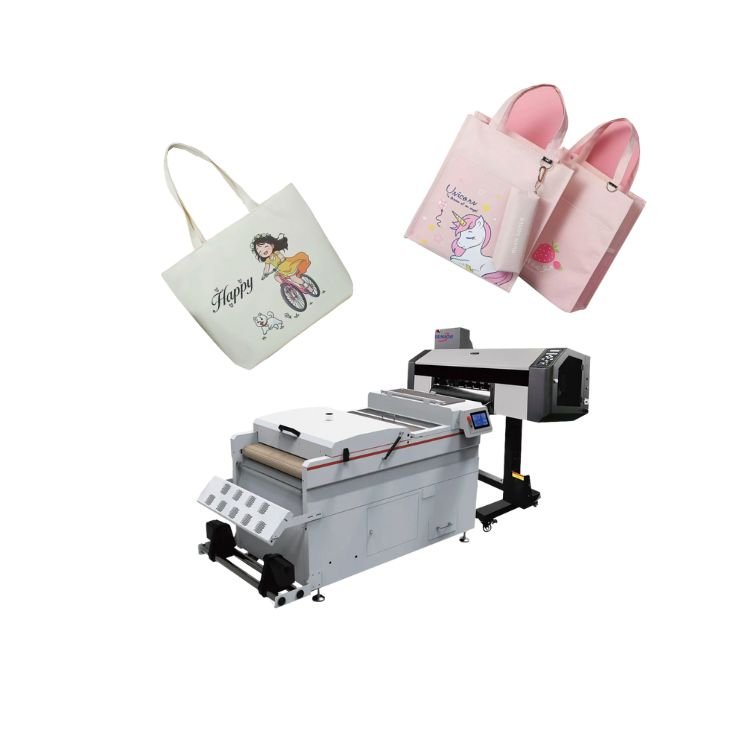
DTF (Direct to Film) printing transfers designs from a film onto fabric with heat and adhesive powder.
It works on many materials — cotton, polyester, canvas, nylon, leather, and more.
DTF printing produces bright colors, strong adhesion, and excellent washing durability.
Best for:
Small logos and local designs
Custom T-shirts and bags
Mixed fabric materials
What Is Sublimation?
Sublimation uses special ink and paper. Heat transfers the design to polyester or coated blanks.
- Fabrics: polyester or coated products
- Look: full-color images, smooth gradients, photo detail
- Feel: no extra layer, ink bonds with fibers
- Limit: no cotton, no dark fabric
Sublimation fits sportswear, mugs, phone cases, and bulk custom gifts.
Recent research confirms that sublimation printing delivers optimal color strength and minimal print mottling on polyester fabrics when performed at controlled heat and pressure conditions — typically around 190 °C for 120 seconds or 210 °C for 60 seconds.
(Toshikj & Prangoski, 2023, ResearchGate link)
Vinyl vs Sublimation: Clear Differences
Fabric use
- Vinyl works on cotton, polyester, blends
- Sublimation works only on polyester or coated blanks
Design style
- Vinyl shows bold colors and special textures
- Sublimation shows smooth detail and photo quality
Fabric color
- Vinyl works on dark and light colors
- Sublimation works only on light colors
Durability
- Vinyl stays strong with proper heat press
- Sublimation becomes part of the fiber and lasts long
Cost
- Vinyl costs less to start
- Sublimation needs a printer, ink, and heat press
How To Choose
- Pick vinyl for cotton shirts or dark fabrics
- Pick sublimation for photo prints on polyester
- Pick vinyl for glitter or holographic effects
- Pick sublimation for large runs on light polyester
Conclusion
Vinyl vs sublimation is a choice of fabric and design. Vinyl gives flexibility and strong color on many garments. Sublimation gives smooth detail and photo quality on polyester. Match the method to your project. Get the best result every time.
Simple Rule for Choosing Between DTF and Sublimation Printing
For large designs (full fabric printing) → Choose Sublimation Printer
→ Lower cost, high efficiency, ideal for polyester fabrics.
→ Examples: Sportswear, bedding, curtains, fabric rolls.
For small designs (logos or partial prints) → Choose DTF Printer
→ Works on various materials (cotton, nylon, leather, etc.), strong adhesion, vivid colors.
→ Examples: T-shirt chest logos, hat emblems, small custom items.
📌 In one sentence:
Choose Sublimation for large prints; choose DTF for small prints.