

DTG printer news in 2026 still shows strong demand in custom apparel printing, especially for T-shirts, hoodies, denim, canvas bags, and small-batch clothing orders. While DTF printing and UV printing are growing fast, DTG printing is still valuable for businesses that need soft hand feel, detailed color output, and on-demand garment printing.
Latest DTG Printer News and Trends in 2026
DTG printer news in 2026 is not only about new machines. The real change is how print shops use DTG printing in daily production.
Many small clothing brands, custom T-shirt shops, and online sellers still need direct garment printing. They want short runs, fast samples, soft hand feel, and full-color designs. This is where DTG printing still has value.
DTF printing is growing fast. UV printing is also used in more custom products. But DTG has not disappeared. For cotton T-shirts, hoodies, denim, canvas bags, and custom apparel orders, DTG printing is still a practical choice.
White Ink Printing Is Still a Key Point
White ink is still very important in DTG printing.
For black T-shirts, hoodies, and other dark fabrics, white ink works as the base layer. Without a good white ink layer, the final color will look weak. A stable white ink system helps the image look brighter and cleaner.
This is one reason many buyers still care about white ink DTG printers.
Wider Color Output Is Becoming More Useful
Basic CMYK printing is not always enough for garment designs.
Some designs need stronger red, orange, green, or blue. Fashion graphics, brand logos, cartoon images, and detailed artwork often need a wider color range.
A 9-color DTG printer can help improve this part. It gives more room for color matching and makes the printed result closer to the original design.
Dual-Station Machines Help Save Time
For small batch garment printing, speed is not only about printing speed.
Loading and unloading also take time.
A dual-station DTG printer can make the workflow smoother. One garment can be prepared while the other one is printing. This is useful for custom shops that print T-shirts, hoodies, sweatshirts, and canvas products every day.
DTG and DTF Are Used for Different Jobs
DTG and DTF are often compared, but they are not the same process.
DTG prints directly on the fabric. The hand feel is softer, especially on cotton materials. DTF uses transfer film and can work on more fabric types.
In real production, many print shops do not choose only one method. They use DTG for soft cotton garments and DTF for transfer jobs or mixed fabric orders.
That is why DTG printing still has a place in 2026.
What is a DTG printer?
DTG Printer direct-to-garment printer on cloth. is a type of printing machine that directly prints patterns onto fabrics. This type will save a lot of working time and costs. easy to operate.
- Design patterns from software
- Use DTG Printers to print patterns on fabrics
- Heat press the complete patterns to be more vibrant and durable
Create your design on the computer
Print the design on the fabric with a DTG printer
Heat press the print to lock in color and improve durability
This process makes DTG printers a strong choice for personalized custom T-shirts.
Advantages of DTG printing for Custom Apparel Orders
High-Quality Printing
A DTG printer creates sharp, colorful, and detailed prints. It can handle complex patterns, small letters, and vivid images. This makes it perfect for custom T-shirts, hoodies, or small-batch products. Many online shop owners choose DTG because they can process orders quickly and meet customer needs.
Cost-Effective for Small Orders
Unlike screen printing, DTG does not need a minimum order. Even if a customer wants one single T-shirt, you can print it right away. For small businesses, this reduces risk and increases flexibility. It is easy to test new designs without big investments.
Environmentally Friendly
Environmental protection is also an important topic in 2025; DTG printers use water-based inks. These inks reduce harmful chemicals and improve safety for both the operator and the customer. They also cut down waste and prevent overproduction. This makes DTG printing a greener choice for modern businesses.
Widely Application
DTG printers most use cotton-based material; cotton materials have good breathability. For example, you can print T-shirts, sweatshirts, tote bags, and socks. prefer to print customized products. This flexibility helps expand product lines for custom shops.
Limitations of DTG Printing
Despite many strengths, DTG printers also have limits. They work best on cotton fabrics. Printing on polyester, nylon, or silk often fails. Printing on dark garments also requires pretreatment. These factors can limit application in some cases.
To overcome this, hybrid DTG printers have appeared. These machines combine DTG and DTF printing. They can print on more types of fabrics and extend business opportunities.
Is DTG Printing Still Worth It in 2026?
Of course, DTG printers are also welcome in 2025. Because the DTG machine offers quality prints, fast production, and eco-friendly operation. While fabric limitations exist, hybrid models are expanding the potential of this technology. For anyone starting a custom apparel business, a direct-to-garment t-shirt printer is still a smart choice.
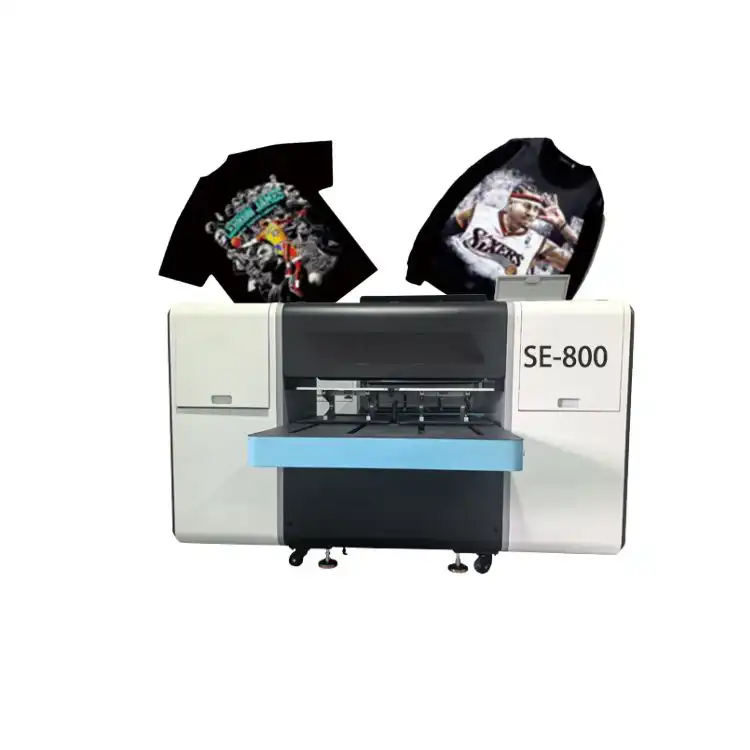
Senior SE-DTG-800 DTG Printer for Garment Printing
For garment printing businesses that need more color range and better white ink output, the Senior SE-DTG-800 DTG printer is one practical machine option.
It is designed for custom T-shirt printing, hoodie printing, denim printing, canvas bag printing, and small to medium batch apparel orders. The dual-station structure helps operators prepare one garment while the other one is printing. This makes the workflow smoother for daily production.
9-Color Printing for Wider Color Output
The SE-DTG-800 supports a 9-color printing system: C + M + Y + K + O + R + G + B + W.
Compared with a basic CMYK setup, this wider color system gives more room for detailed garment designs. It is useful for fashion graphics, brand logos, cartoon artwork, and full-color custom prints.
White Ink Support for Light and Dark Fabrics
White ink is important for DTG printing, especially on black T-shirts, hoodies, and other dark garments.
The SE-DTG-800 uses white ink to build the base layer before color printing. This helps the printed design look brighter and more solid on dark fabrics.
Flexible Printing Area for Different Garment Orders
The machine supports a printing area from 450 × 550 mm to 700 × 800 mm, with optional customization.
This makes it suitable for different garment sizes and product types. Print shops can use it for T-shirts, sweatshirts, denim jackets, canvas bags, and other textile products.
Epson Printhead Options and Daily Production Use
The SE-DTG-800 can be configured with Epson 1600 or i3200 printheads. It supports high-resolution printing up to 1200 dpi, which helps produce clear image details and smooth color output.
The machine is also designed with 360° printhead protection and easy platen replacement. These details are useful for shops that handle different garment orders every day.
Who Is This DTG Printer Suitable For?
This machine is suitable for custom apparel shops, small clothing brands, online sellers, and print businesses that need direct-to-garment production.
It is a good fit for businesses that print short runs, samples, personalized clothing, and small batch garment orders.
If you are comparing DTG printer options for custom garment printing, the SE-DTG-800 DTG printer can be used as a reference model for 9-color white ink DTG production.