
Quick Answer: Best Film for Heat Transfer Labels
If you are choosing the best film for heat transfer labels, compare UV DTF film, DTF paper, and PET film based on application, material, thickness, ink adhesion, transfer rate, and stability. Different films are designed for different products, so the right choice depends on whether you print hard-surface crystal labels, textile transfers, packaging labels, or custom logo stickers.
| A Film Type | Suitable Surface / Scene | Main Effect |
|---|---|---|
| Transparent A Film | Glass, acrylic, and light-colored hard surfaces | Clear background and clean details |
| White Base A Film | Dark or colored substrates | Brighter colors and better coverage |
| Matte A Film | Electronics and home decoration products | Soft surface with low reflection |
| Metallic A Film | Premium packaging and brand logos | Gold or silver metallic effect |
| Glitter: A Film | Gifts, accessories, and custom designs | Sparkling effect and eye-catching finish |
For buyers, the key comparison is not only UV DTF vs. DTF but also film thickness, PET or PVC base material, ink adhesion, transfer rate, release stability, and the final application surface.
UV DTF film selection depends on your application, not just price. Choosing the right UV DTF film is critical for achieving stable transfer results, strong adhesion, and long-term durability. For hard-surface applications such as packaging, branding, and electronic product labeling, TPU-based crystal label film delivers smooth, glossy, and high-precision results. For textile-related applications, embroidery-effect film creates a 3D embroidered appearance without traditional stitching.
The key is simple: choose the UV DTF film based on your final product, material type, and visual requirements.
UV DTF film has become one of the fastest-growing transfer materials in digital printing. Many users search for UV DTF film thickness, PET UV DTF film, or UV DTF B film material (PVC or PET) to understand which option provides better stability, adhesion, and durability.
In this guide, we explain UV DTF film thickness standards, material differences, and how UV DTF film compares with traditional DTF transfer materials.
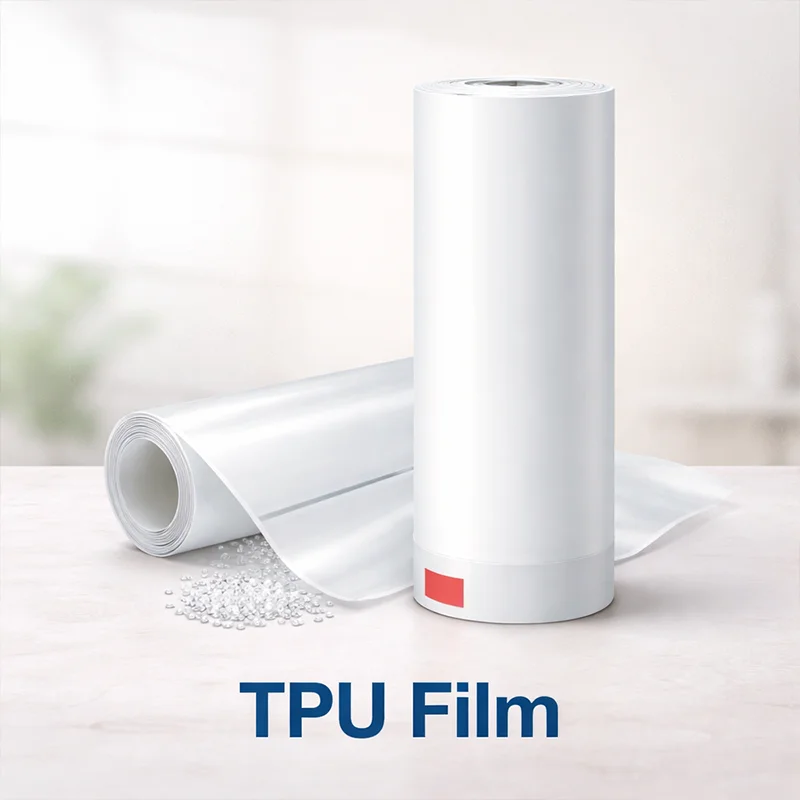
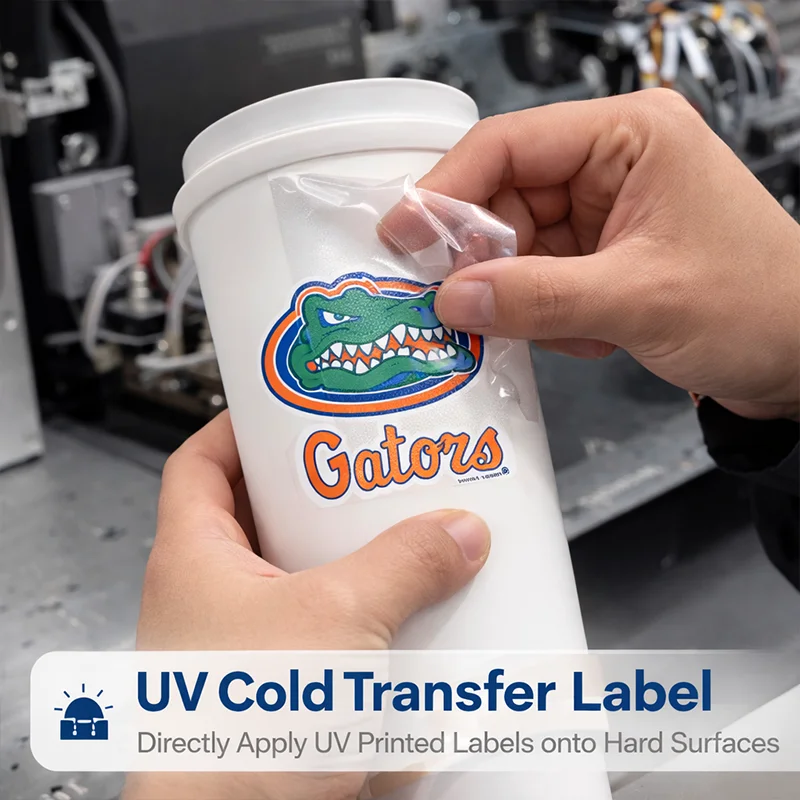
TPU Cold Transfer Film and Its Applications
DTF vs. UV DTF: What Is the Real Difference?
DTF and UV DTF printing differ in process, materials, and application.
DTF (Direct to Film) uses a heat transfer process. The workflow includes printing, applying adhesive powder, shaking excess powder, and curing at high temperature. The final result is a heat-transfer film that must be pressed onto fabric. This makes DTF ideal for textiles such as T-shirts, garments, and soft materials.
UV DTF, on the other hand, is a simplified process. The printer produces the design and automatically laminates it with transfer film, eliminating the need for powdering and baking. The finished output is a ready-to-use sticker that can be directly applied to hard surfaces without heat.
In terms of application, DTF is limited to fabric due to the heat transfer requirement, while UV DTF is widely used for hard materials such as glass, acrylic, wood, plastic, and metal.
Another key difference is the film system. DTF typically uses a single PET film, while UV DTF requires a combination of A film (printing film) and B film (adhesive transfer film). After printing, the B film is laminated onto the A film, allowing the design to be transferred easily onto the final surface.
In short: DTF is for fabric with heat transfer, while UV DTF is for hard surfaces with direct application.
Key Differences Between DTF and UV DTF
| Feature | DTF Printing | UV DTF Printing |
|---|---|---|
| Process | Print + Powder + Bake | Print + Lamination |
| Heat Required | Yes | No |
| Application | Fabric only | Hard surfaces |
| Film Type | PET film | A film + B film |
| Equipment | Powder shaker needed | No powder system |
| Workflow | More complex | Simpler |
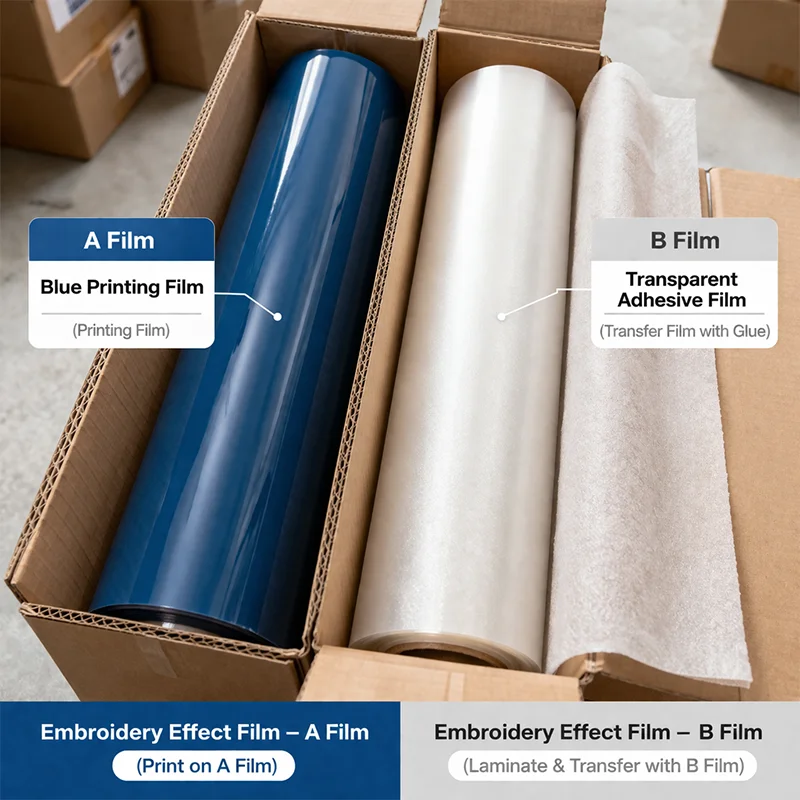
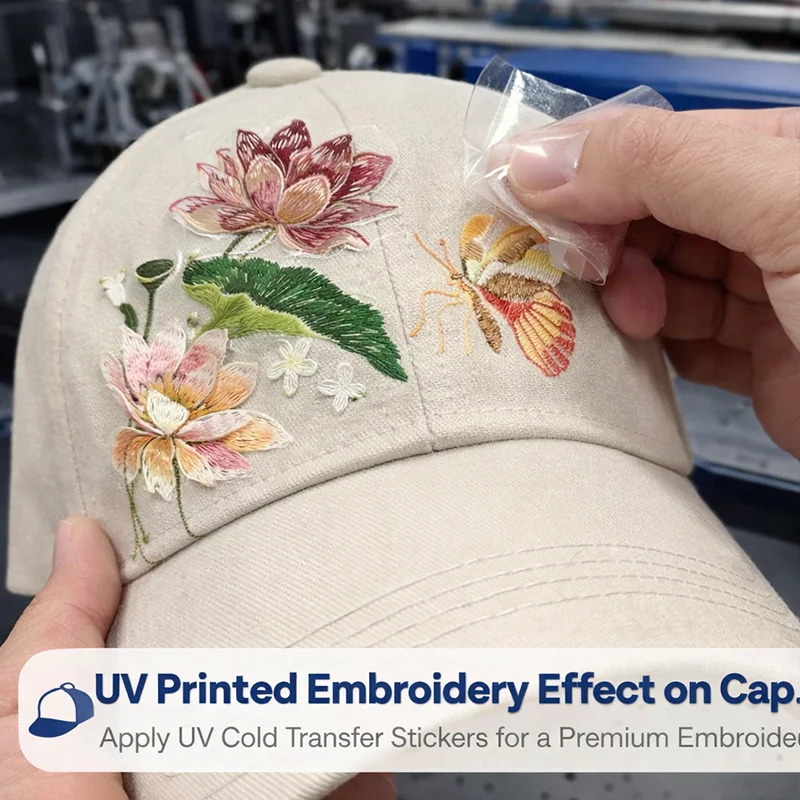
Embroidery-effect film and Its Applications
What Is Standard UV DTF Film Thickness?
One of the most searched questions in Google is
What is the standard UV DTF film thickness?
Typical market specifications:
A Film Thickness: 75 to 100 microns
B Film Thickness: 50 to 75 microns
Total Transfer Thickness: 120 to 180 microns
Thickness directly affects:
- Release performance
- Transfer stability
- Bubble control
- Edge lifting
- Long-term adhesion
Higher-quality PET UV DTF film maintains strong stability even under temperature fluctuation.
UV DTF B Film Material: PET or PVC?
Another common search query is
Is UV DTF B film made of PVC or PET?
PET-Based UV DTF Film (Mainstream Choice)
Most professional UV DTF film manufacturers use PET base material because:
- High thermal stability
- Low shrinkage rate
- Strong tensile strength
- Excellent ink adhesion
- Better flatness during printing
PET UV DTF film is considered more stable for high-resolution crystal label production.
PVC-Based UV DTF Film
Some lower-cost UV DTF paper or film solutions may use PVC material. While PVC can reduce production cost, it may:
- Shrink under heat
- Curl during storage
- Show lower dimensional stability
- Affect transfer alignment
For industrial production, PET UV DTF film remains the preferred material.
How to Judge UV DTF Film Quality: Ink Adhesion, Transfer Rate, and Stability
Ink Adhesion:
Check whether the transfer material is properly pre-treated. For smooth surfaces such as ceramic and metal, apply a suitable primer coating first. Different materials need different coating liquids. Excessive UV lamp power or over-curing may reduce ink adhesion.
Transfer Rate:
When applying UV DTF crystal labels to mugs, bottles, and similar products, dust or oil film may remain on the surface. Clean the surface with alcohol before application. This helps the sticker bond firmly and improves the transfer rate.
Stability:
Film stability depends on the PET base material, thickness control, film flatness, and low shrinkage performance.
Final Result:
High-quality UV DTF film should provide clean peeling, strong adhesion, a glossy finish, and clear 3D crystal label effects.
Does UV DTF Film Thickness Affect Transfer Quality?
Yes.
UV DTF transfer thickness impacts:
- Adhesion strength
- Scratch resistance
- Surface gloss level
- Long-term durability
If the film is too thin:
- It may tear during peeling
- Stability decreases
If too thick:
- Transfer may feel rigid
- Edge bonding may weaken
Choosing the correct UV DTF film thickness ensures excellent ink adhesion, a high transfer rate, and strong stability.
UV DTF Film vs DTF Paper (Textile Use)
It is important to clarify:
UV DTF film and DTF paper serve different markets.
| Feature | UV DTF Film | DTF Paper |
|---|---|---|
| Application | Hard surfaces | Fabric |
| Base Material | PET / PVC | Paper-based |
| Thickness | 120–180μm total | Usually thinner |
| Waterproof | Yes | Limited |
| Scratch Resistant | Yes | No |
| Wash Durable | Not for fabric | Designed for fabric |
UV DTF paper and film are designed for:
- Glass
- Acrylic
- Plastic
- Metal
- Wood
- Promotional products
Traditional PET DTF film or DTF paper-based heat transfer film is mainly for garments.
Why UV DTF Film Is More Stable
When users search:
dtf film strong stability
dtf film excellent ink adhesion and a high transfer rate
They are usually comparing material quality.
High-quality PET UV DTF film offers:
- Excellent ink adhesion
- High transfer rate
- Strong dimensional stability
- Low deformation
- Consistent thickness control
This ensures smooth peeling and high-definition 3D crystal effects.
For customers producing textured labels, crystal labels, and premium logo transfers, using the right printer is also important. A UV printer for 3D raised logos can help build clear white ink layers, vivid color, and varnish effects for more dimensional branding applications.
Which Film Is Best for Your Business?
soft materials such as clothing and T-shirts. → DTF
Custom gift business → UV DTF
Industrial labeling → UV DTF
For hard surface label production, choosing the right film is only one part of the process. You can also compare our UV printers for crystal labels to find a suitable machine for UV DTF stickers, 3D raised labels, and product logo printing.
Final Recommendation
Choose UV DTF film if:
- You need stable production
- You want high-definition crystal labels
- You require strong scratch resistance
- You prioritize long-term durability
Choose DTF paper or PET DTF film (textile) if:
- You print on fabric
- Wash durability is required
- Soft hand-feel is important
Understanding UV DTF film thickness and material differences helps you avoid instability and choose the right transfer solution for your business.
FAQ About UV DTF Film and DTF Transfer
What is the difference between DTF and UV DTF?
DTF is used for fabric and requires heat transfer. UV DTF is used for hard surfaces and does not require heat. UV DTF creates a ready-to-use sticker for glass, plastic, metal, ceramic, and packaging materials.
What is the standard UV DTF film thickness?
The standard UV DTF film thickness is usually 120 to 180 microns in total. A film is commonly 75 to 100 microns, and B film is commonly 50 to 75 microns. Proper thickness helps improve adhesion, peeling, and transfer stability.
What makes PET UV DTF film more stable than PVC film?
PET UV DTF film has better flatness, stronger dimensional stability, and smoother gloss. It helps reduce bubbles and orange peel texture. PVC film is more cost-effective and suitable for short-term designs or budget projects.
What does high transfer rate mean in UV DTF film?
High transfer rate means the design releases cleanly and transfers completely. If peeling is incomplete, check surface cleaning, B film matching, UV curing settings, humidity, and peeling method.
Is UV DTF film suitable for fabric?
Standard UV DTF film is mainly used for hard surfaces. It is not suitable for all fabrics. For garments, DTF film, DTF paper, or embroidery-effect UV DTF film is usually a better choice.